
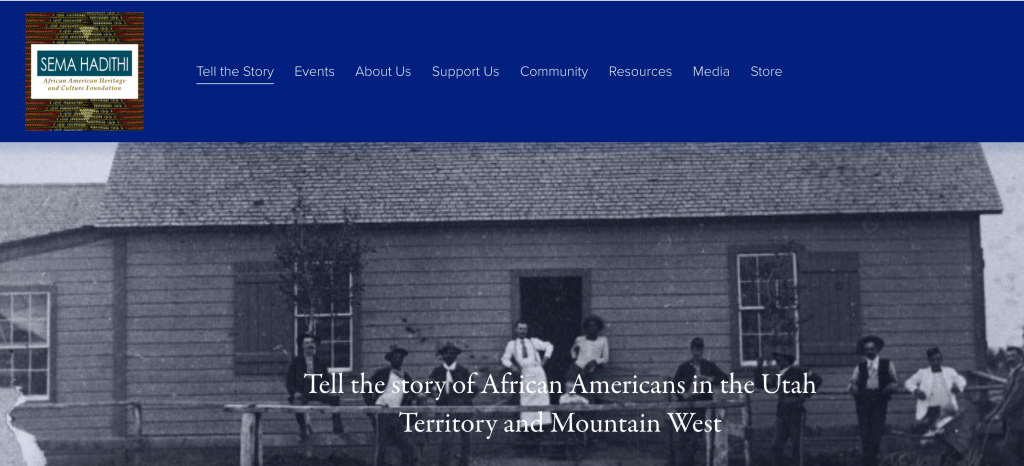
Black Lives Bless would like to spotlight the work of Sema Hadithi African American Cultural Foundation by highlighting their website https://semahadithifoundation.org/ . This spotlight was contributed to Black Lives Bless by Carolyn Cannon Jenkins, a volunteer Black Lives Bless content contributor.
One of my “end of the year” resolutions is finding an organization I like to support in different ways throughout the year. I found just the one in The Sema Hadithi African American Cultural Foundation. The organization was founded in 2020 by Robert S. Burch and describes itself as a “destination of cultural preservation and historical storytelling in Utah”. Its name, Sema Hadithi, “tell the story”, in Swahili, underpins the mission of this organization which is to “research, preserve, and share the rich history, heritage, and culture of African-ancestored people in the state.”
As with other organization I support, I decided to take a quick look at the Foundation’s website. Predictably, this quick look turned into several hours of exploration. The website is both fascinating and highly informative. There are limitless possibilities of topics to survey on the website from podcast, reading lists, volunteer opportunities, to accounts of past and future Sema Hadithi events. Initially, I chose to sign up for museum access based on this intriguing introduction: “Each of our museum rooms focuses on a specific aspect of history. Since the influence of African Americans in Utah has been broad and wide, the stories we share here are just as expansive.” The four museum rooms are Black Women, Buffalo Soldiers, Preservation and Future projects. Utah history is abundant with stories of white pioneers and other white influential people, but it was refreshing and novel to read the stories of four Black women in the Black Women “room” https://semahadithifoundation.org/ourblackwomen . Alice “Allie” Steward, Elnora Dudley, Thelma Steward Beridon, and Alberta Henry, were influential in their communities and faced fierce discrimination while living in Salt Lake City.
Allie Steward taught her 12 children to “stand up for themselves when faced with discrimination and abuse. With the strong leadership and kindness that Allie showed to her children and neighbors, many of her children became civil rights activist and blazed paths for Black people in Utah and other Western states.” Elnora Dudley was the queen of the 1898 Salt Lake City Emancipation Day celebration. She was a talented pianist and often played at community celebrations and weddings. Both Thelma Beridon and Alberta Henry faced discrimination when trying to advance professionally in Salt Lake City. Left with no other options, they both became domestic houseworkers despite having business and management experience and skills. What struck me was that I am a fifth generation Utah white woman, and I had never heard any of these stories.
Likewise, the stories of Buffalo Soldiers were new to me. In the Buffalo Soldiers “room” https://semahadithifoundation.org/ourbuffalosoldiers , I learned a little-known part of both Utah history and American History. “The story of the Buffalo Soldiers is an inspiring tribute to the unsung heroes who met extraordinary challenges head-on…. members of the 9th calvary, a unit of the black military men known by the Native Nations as Buffalo Soldiers, are charged with protecting Mormon settlers in the stark desert plains of the Utah Territory; even as they battle discrimination on the post and in the settlements.” Reading the accounts left me curious about the interactions among Native Utahns, White settlers and the Black Buffalo Soldiers. Luckily, there are exciting plans for commemorating the Buffalo Soldiers including the establishment of the Buffalo Soldier Trail and a Buffalo Soldier graphic novel, both will be vital for retelling their history.
Most sobering was reading the accounts of William Harvey, Thomas Coleman, and Robert Marshell, Black men who were lynched in Utah. Spending time in this “room” https://semahadithifoundation.org/ourpreservation , I had to wrestle with the common phenomenon of lynching. “This was not “frontier justice” carried out by a few marginalized vigilantes or extremists. Instead, many African Americans who were never accused of any crime were tortured and murdered in front of picnicking spectators (including elected officials and prominent citizens)…” I had learned about the lynchings of Blacks, but not about lynchings in Utah. This is an extremely hard history to confront, but it is a history that needs to be told and recognized as Utah history.
The last “room” I visited listed several exciting “Future Projects” https://semahadithifoundation.org/future-projects , each project involving a “working group” that researches, preserves, and shares the rich history of Blacks in the state of Utah. I look forward to this organization’s future projects. They will be important contributions to our community.
If it weren’t for the efforts of organizations such as Sema Hadithi, a precious and powerful aspect of Utah history would be lost. We would miss the opportunity to learn from those who had no voice, experienced injustice, and were not recognized for courageous acts; yet, they were a part of and helped shape Utah history.
Black Lives Bless will continue to highlight Sema Hadithi events from the past as well as future happenings.
Carolyn Cannon Jenkins is a volunteer content contributor to Black Lives Bless. She is one of the founding members of the group- Descendants for Racial Reconciliation.

 Black Lives Bless